Four Sets ATEX certified Explosion proof 185CFM Sullair Diesel driven zone 2 air compressors for applications in Hazardous Area ( Zone 2 ) mounted in the DNV certified 2.7-1 Skid have been successfully pass through ATEX and DNV certificate ready to send to client.
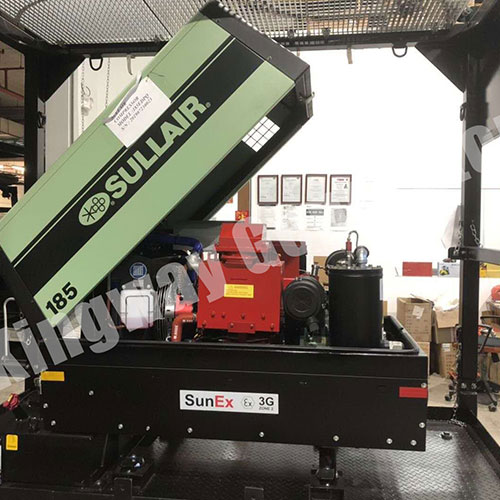
Kingway hazardous area equipment department always commit to the safe, reliable and enhanced performance Zone 2 equipment in projects in oil & gas field or industry, offshore & onshore service. As one of the top brand of hazardous area explosion proof solution, is your reliable and trusted partner in explosion proof industry.
Before, seeing the expression "Hazardous Location" ordinarily implied that the hardware being mentioned was bound for a compound plant, treatment facility, or penetrating stage. Today, we are seeing hazardous areas in sugar factories, grain storerooms, and anyplace there might be combustible fluids, gasses, or dust present. Hazardous regions are characterized as territories where the presence of combustible gases or fluids, flammable tidies, or effectively touched off strands exist in adequate fixations to cause a fire or blast, given a wellspring of start. These regions run from segments of a space to entire plant locales.
Mostly because of this extended utilization of the order framework, specifiers are progressively referring to prerequisites for gear appropriate for use in characterized regions. When appropriately utilized, the hazardous region order framework makes for a more secure workplace. Time and again, notwithstanding, risk classes are determined without worry for the essentially higher plan and acquirement costs they bring. Much of the time, a receptive outlook and a little resourcefulness can evade extreme expenses for blowers and other gear, without bargaining security.
There are a few contrasts between the order framework in North America and the framework utilized in different pieces of the world. In North America, the most well-known technique for characterizing hazardous territories is by Class, Division, and Group. Classes are utilized to recognize the sort of material that might be found in the environment:
Class I - Flammable gases and fumes in amounts adequate to create ignitable or dangerous blends
Class II - Combustible or conductive cleans present in the climate
Class III - Ignitable strands or flyings are in the climate, however not liable to be in adequate amounts to deliver ignitable blends.
Divisions are utilized to recognize the likelihood that an ignitable substance will be in the climate in fixations that would uphold start:
Division 1 - The substance is available during typical working conditions. This is additionally characterized as being over 10 hours out of every year.
Division 2 - The substance is absent during ordinary working conditions and is available just when a strange condition exists. This is additionally characterized as being between 1 hour and 10 hours out of every year.
Unclassified - In an office with Class I or Class II territories, any territory where centralizations of gases, fumes, or residue adequate for start are available under 1 hour out of every year are recorded as Unclassified.
Gatherings are recorded as A through G. Gatherings A through D distinguish gases and fumes and apply to Class I areas. Gatherings E through G recognize ignitable cleans and apply to Class 11 areas. The level of combustibility is in sequential order, with A being the most combustible and D being the least combustible gases and fumes, and E being the most combustible and G being the least combustible tidies.
These orders can be found in National Fire Protection Association (NFPA) Section 500 and 505. Area 505 is a more up to date segment that is organized to orchestrate the NFPA codes with the Zone evaluations utilized outside of North America.
In Europe and different pieces of the world, a Zone rating is utilized. This is like the North American framework with some slight contrasts.
Zone 0 - A climate where a blend of air and combustible gas, fume, or fog is available regularly, consistently, or for extensive stretches of time. This is additionally characterized as 1000 hours of the year or more.
Zone 1 - An air where a blend of air. Also, combustible gas, fume, or fog is probably going to happen during typical tasks infrequently. This is additionally characterized as over 10 hours however under 1000 hours of the year.
Zone 2 - An air where a blend of air and combustible gas, fume, or fog isn't probably going to happen in typical activity in any case, in the event that it happens, will endure for just a brief timeframe. This is additionally characterized as over 1 hour however under 10 hours of the year.